
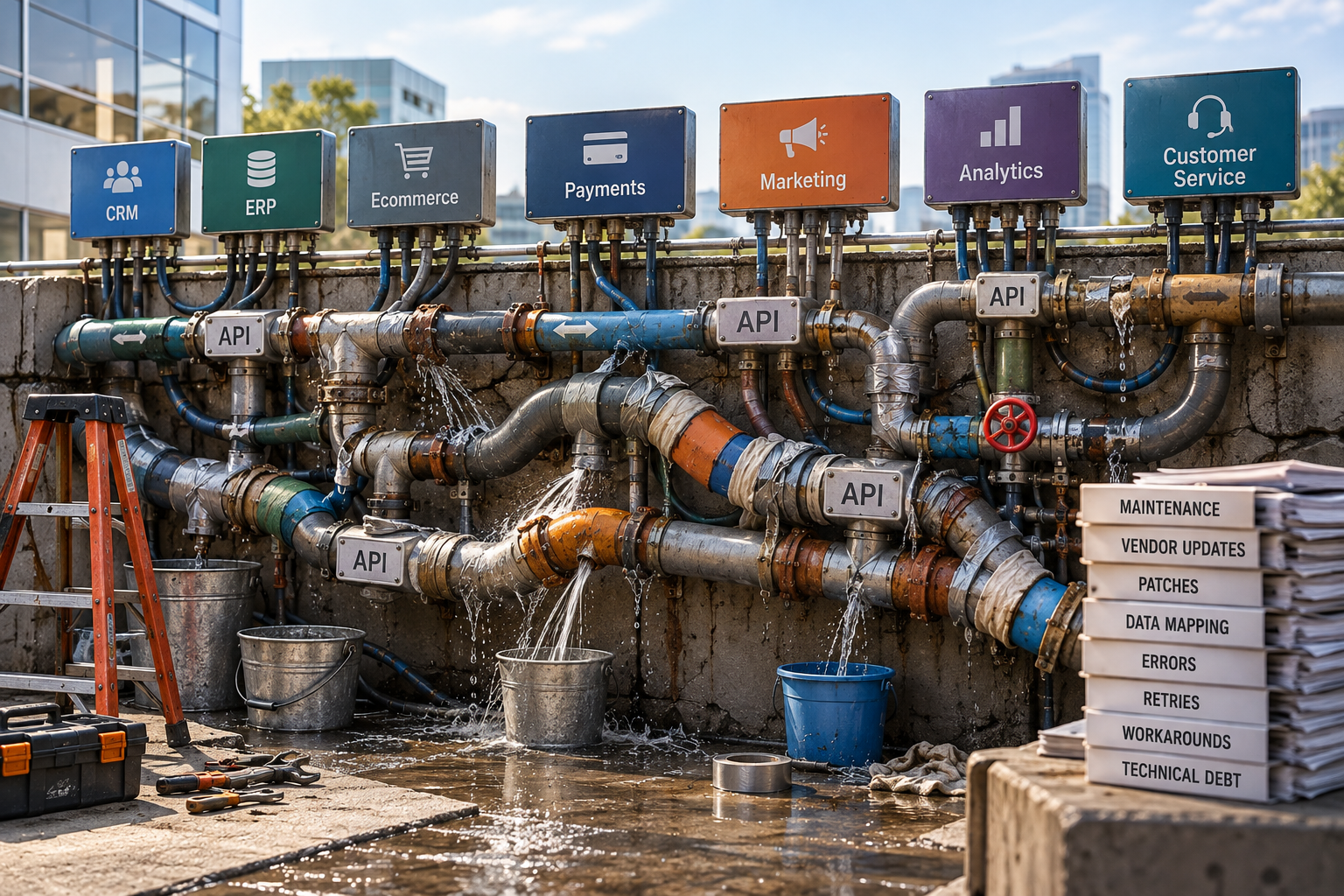
Modern businesses increasingly rely on specialized SaaS platforms connected through APIs. This model gives organizations the flexibility to choose the best tools for different functions, from customer management and billing to analytics and fulfillment. It also creates a growing layer of dependency that is easy to overlook. Data may pass through multiple systems, transformations, and vendors before it reaches its final destination, often with no single team responsible for the entire path. As those connections multiply, integration becomes part of the organization’s architecture, shaping reliability, scalability, and how quickly teams can adapt when systems change.
What is The API Economy?
The API economy describes the growing model in which companies build products and operations by connecting software platforms, data, and services through APIs. Instead of relying on a single platform to handle every function, companies can combine specialized tools for sales, finance, fulfillment, analytics, customer service, and other parts of the operation. In Postman’s 2025 State of the API Report , 82% of surveyed organizations said they had adopted some level of an API-first approach .
Each additional platform, however, adds relationships that the business must continue to manage. A customer order might move from an ecommerce system into an ERP, trigger activity in a warehouse platform, update a CRM, and eventually feed several reports. Each handoff depends on APIs, data mappings, and business rules behaving as expected.
As we discussed in our article on the Frankenstein tech stack , those individual connections can gradually form a much more complicated system than anyone intentionally designed. The larger the ecosystem becomes, the harder it can be to answer basic questions about where data originates, how it changes along the way, and who owns the connections carrying it.
Integration Problems Rarely Look Like Outages
The hardest integration failures often leave every application looking healthy. An API can continue responding even as the data moving through it becomes incomplete, delayed, or incorrectly mapped. A changed field name, revised data format, or updated business rule may create downstream errors without causing an obvious system failure.
That can lead to missing customer records, duplicate entries, delayed orders, inconsistent reports, or automated workflows that just stop triggering. Because the visible symptom may appear several systems away from the original issue, diagnosing the problem can require tracing data across multiple applications and transformations.
This is one of the hidden costs of the API economy . The more systems involved in a process, the more places small changes can introduce bad data or break a workflow without bringing the broader application environment down.
Why API Integrations Become Brittle Over Time
Even well-designed API integrations can become harder to maintain as surrounding systems change. Vendors update platforms, revise authentication requirements, deprecate endpoints, and modify data structures. Internal teams also make changes, introducing new fields, workflows, and business rules that alter how data moves between systems. Designing for integration readiness can make those changes easier to accommodate, but integrations still require ongoing maintenance as the surrounding environment evolves.
Documentation does not always keep pace with those changes, and the people who originally built an integration may move to different roles or leave the organization. Over time, the connection can drift away from the assumptions that shaped its original design.
That drift creates more maintenance work. Teams may have to trace failures across multiple systems, reconcile inconsistent data, and determine which upstream change caused the issue before they can fix it. As the number of APIs grows, troubleshooting becomes increasingly difficult to manage connection by connection.
Your Integrations Are Already Part of Your Architecture
As API connections accumulate, they begin to shape how the business actually operates . They determine where data originates, how it moves between systems, which transformations happen along the way, and which downstream processes depend on each connection.
A CRM-to-billing integration, for example, may determine when a new customer account is created and which pricing terms are applied. An ecommerce-to-warehouse connection may control when an order becomes eligible for fulfillment. A data pipeline feeding executive dashboards may depend on several upstream systems agreeing on how fields such as revenue, customer status, or product category are defined. Changes to any one of those connections can affect business processes far beyond the application where the change originated.
Treating that integration layer as architecture means maintaining a clear view of those relationships. Teams should know which systems exchange data, which application serves as the source of truth, where business logic is applied, and who owns each integration. They also need a way to assess downstream impact before changes reach production.
That visibility makes the environment easier to maintain and gives teams a stronger foundation for growth. The same concerns around documentation, ownership, and governance also become increasingly important as organizations adopt AI, where weak foundations can contribute to AI debt . As the company adds new SaaS platforms, APIs, and workflows, those additions can fit into an existing architectural model instead of becoming another isolated connection that someone has to rediscover later.
AI Agents Can Help Organizations Manage API Complexity
As integration environments grow, some of the work required to maintain them becomes repetitive and time-consuming. Reviewing API documentation, translating requirements, generating integration code, and validating expected behavior are all areas where AI agents can help teams move faster while keeping human oversight.
CSG recently worked with ConnectBase , a telecommunications marketplace serving more than 400 providers, to address exactly this kind of problem. Each new provider exposed inventory, pricing, and serviceability through APIs that ConnectBase had to map into its internal systems. The existing process required manual documentation review, custom development, and QA across a nine-person team, with onboarding typically taking four to six weeks.
CSG helped ConnectBase implement a three-agent workflow for requirements synthesis, code generation, and QA validation. The automated API build process now takes about 40 minutes, while total partner onboarding has been reduced to roughly four hours .
That acceleration still sits inside a governed process. Engineers review generated specifications and code, automated tests are logged, artifacts are version-controlled, and integrations continue through security and compliance checks before deployment. For organizations managing a growing API economy, the ConnectBase case study shows how AI agents can increase integration capacity while preserving review, traceability, and control.
Build for the Ecosystem You Actually Have
Organizations that treat APIs as part of their architecture can manage that complexity more easily. Clear ownership, current documentation, dependency mapping, and consistent governance give teams a better way to evaluate changes before they create downstream problems. AI agents can extend that capacity further by reducing the manual work involved in reviewing, building, and validating integrations.
For companies operating across a growing web of connected systems, integration management is becoming a core operational capability. If your team is struggling to keep up with API complexity, CSG can help you design and modernize integration workflows while identifying where AI can reduce manual effort and improve scalability.